Convertible Bridesmaid Dresses: Every Style + How to Wear Them (2026)

All images in this post were created with Try My Dress. Upload your photo and see yourself wearing any dress style in seconds. Try on wedding dresses, guest outfits, or any dress you can imagine. Try it free →
A convertible bridesmaid dress is the closest thing the bridal industry has to a cheat code. One dress, one color, one fabric — and every bridesmaid in your party can style it to flatter her body, her comfort level, and her personal taste. No more chasing down five different sizes of five different cuts and praying the colors match in photos.
This guide covers every common conversion style, exactly how to tie the most popular wrap (step by step), which configurations flatter which body types, and the sizing and fabric pitfalls that trip up most brides. By the end you'll know exactly which convertible dress to recommend to your party — and you can try it on with TryMyDress before anyone places an order.
What Is a Convertible Bridesmaid Dress?
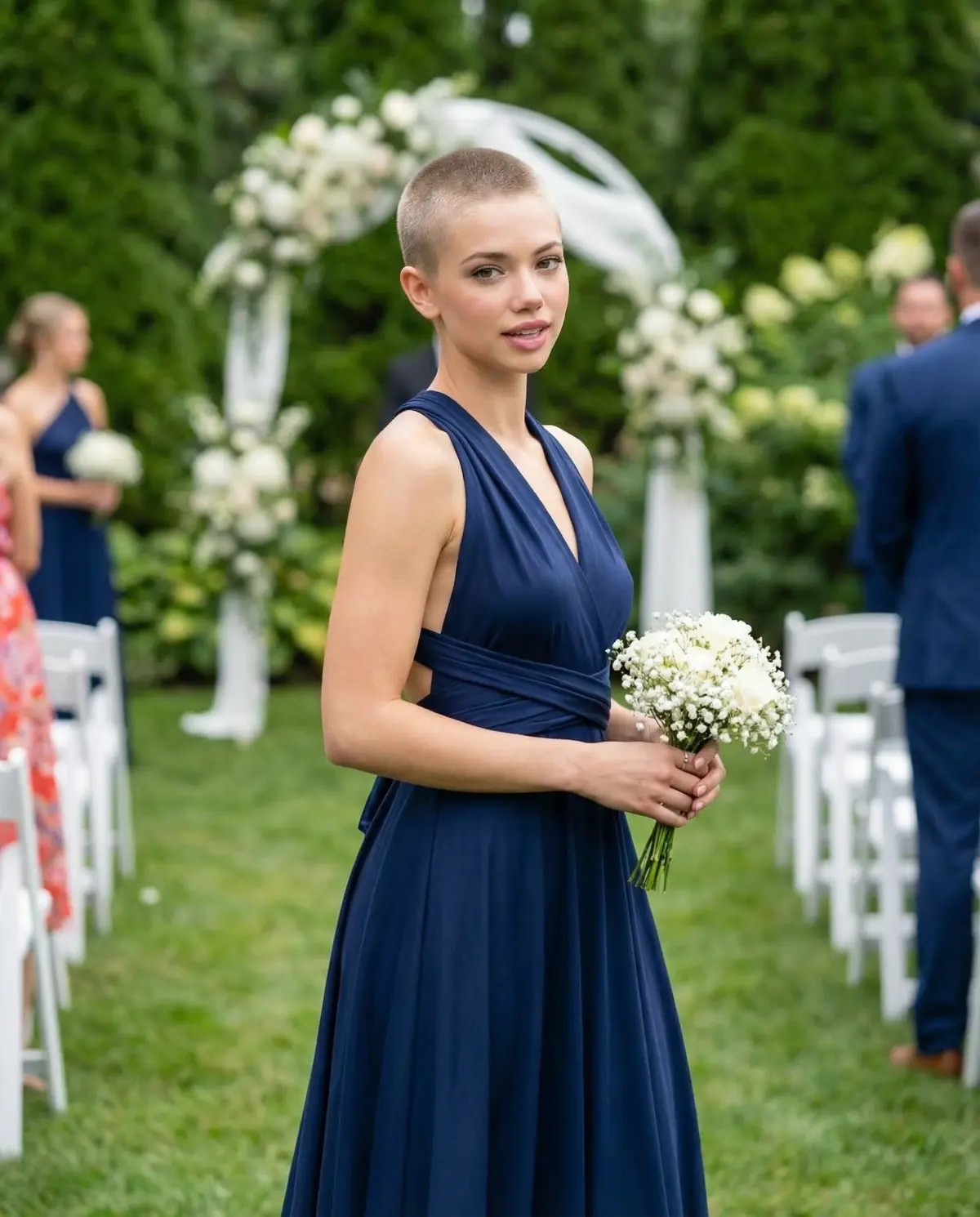
A convertible bridesmaid dress is a single garment — usually a fitted bodice or tube top attached to a maxi or midi skirt — with two long fabric panels (sometimes called sashes, ties, or wings) sewn at the bust. Those panels are long enough to wrap around your torso, cross your back, drape over your shoulders, and tie in dozens of different configurations.
The category goes by several names depending on the brand:
- Convertible dress — the umbrella term used by Azazie, David's Bridal, and BHLDN.
- Infinity dress — the original 2010s term, still used by Henkaa and Coverstory.
- Multi-way dress — a UK favorite, common at ASOS and TFNC.
- Twist-wrap dress — used when the panels are shorter and only twist at the front.
- Grace-style dress — Birdy Grey's flagship convertible, with 20+ documented configurations.
The mechanics are nearly identical across brands. What varies is panel length (longer panels = more configurations), fabric weight (heavier holds shape, lighter drapes prettier), and whether the bodice has a built-in bra or boning. Premium versions like the Birdy Grey Grace add internal hook-and-loop loops so wrap styles stay locked all night.
The 6 Most Common Convertible Styles
Every convertible dress can technically tie 15–20 ways, but six configurations cover 95% of what you'll actually see in a wedding party. Here's each one and when to choose it.
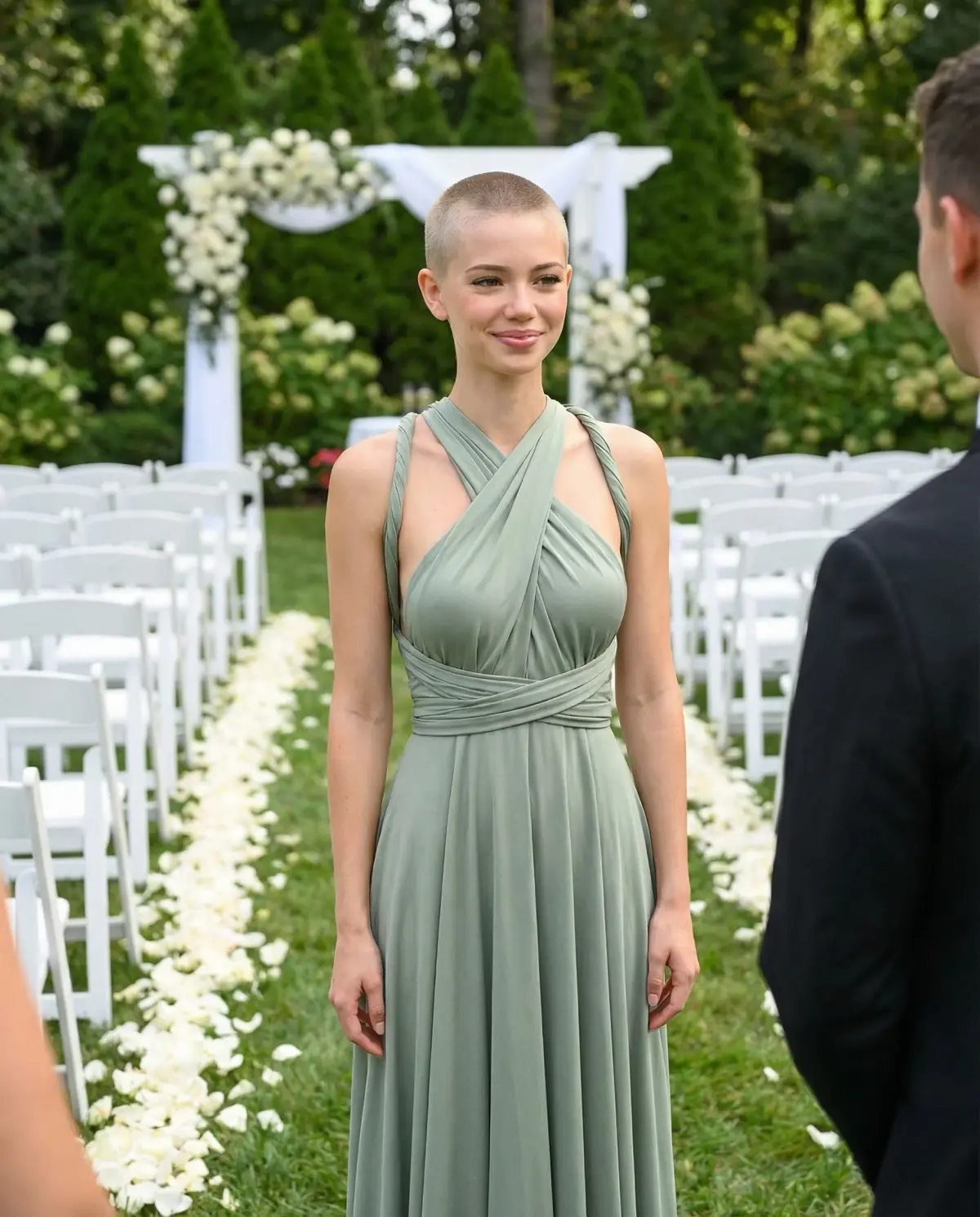
1. Halter
The two panels are pulled straight up from the bust, crossed once at the back of the neck, and tied behind the head (or knotted under the hair). The result is a deep V at the chest with bare shoulders.
Choose halter if: you have a smaller bust, broader shoulders you want to soften, or you want to show off a delicate collarbone necklace. It's also the most secure for dancing — nothing slips because the weight is anchored at the neck.
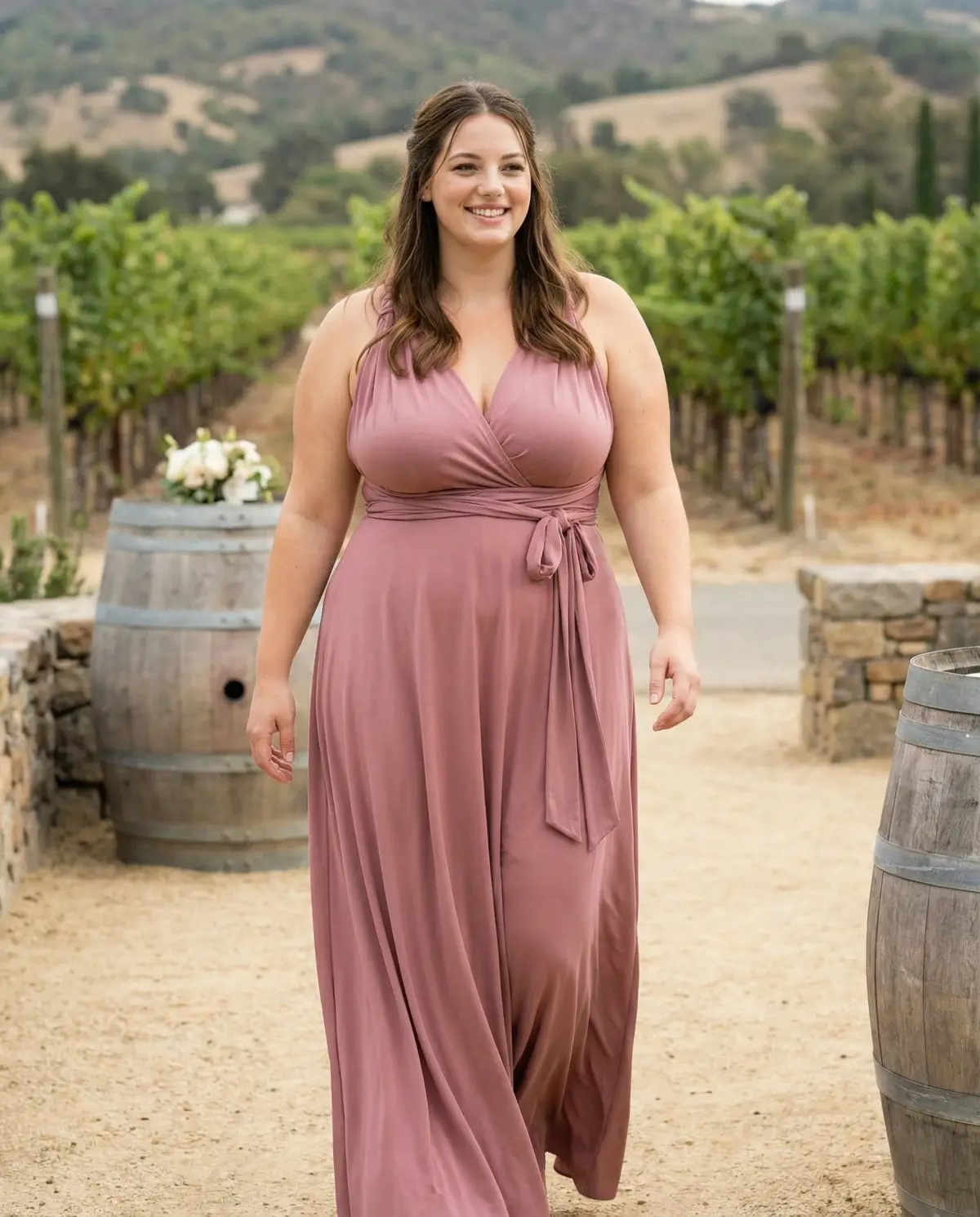
2. Wrap Front (Criss-Cross)
The panels cross over each other at the bust like an X, then wrap around the ribcage and tie at the back. The criss-cross creates a V-shape that lifts and supports a fuller bust.
Choose wrap front if: you have a fuller bust, want maximum support without a strapless feel, or want to lengthen your torso visually. This is the single most flattering option for the most body types — when in doubt, default here.
3. Strapless / Sweetheart
The panels are tucked inside the bodice or tied behind the back so they disappear entirely. You're left with a clean strapless or sweetheart neckline.
Choose strapless if: you want a classic, timeless silhouette that photographs well across decades, or your bridesmaids want consistency with a strapless bridal gown. Bring fashion tape — strapless is the configuration most likely to need a mid-night adjustment.
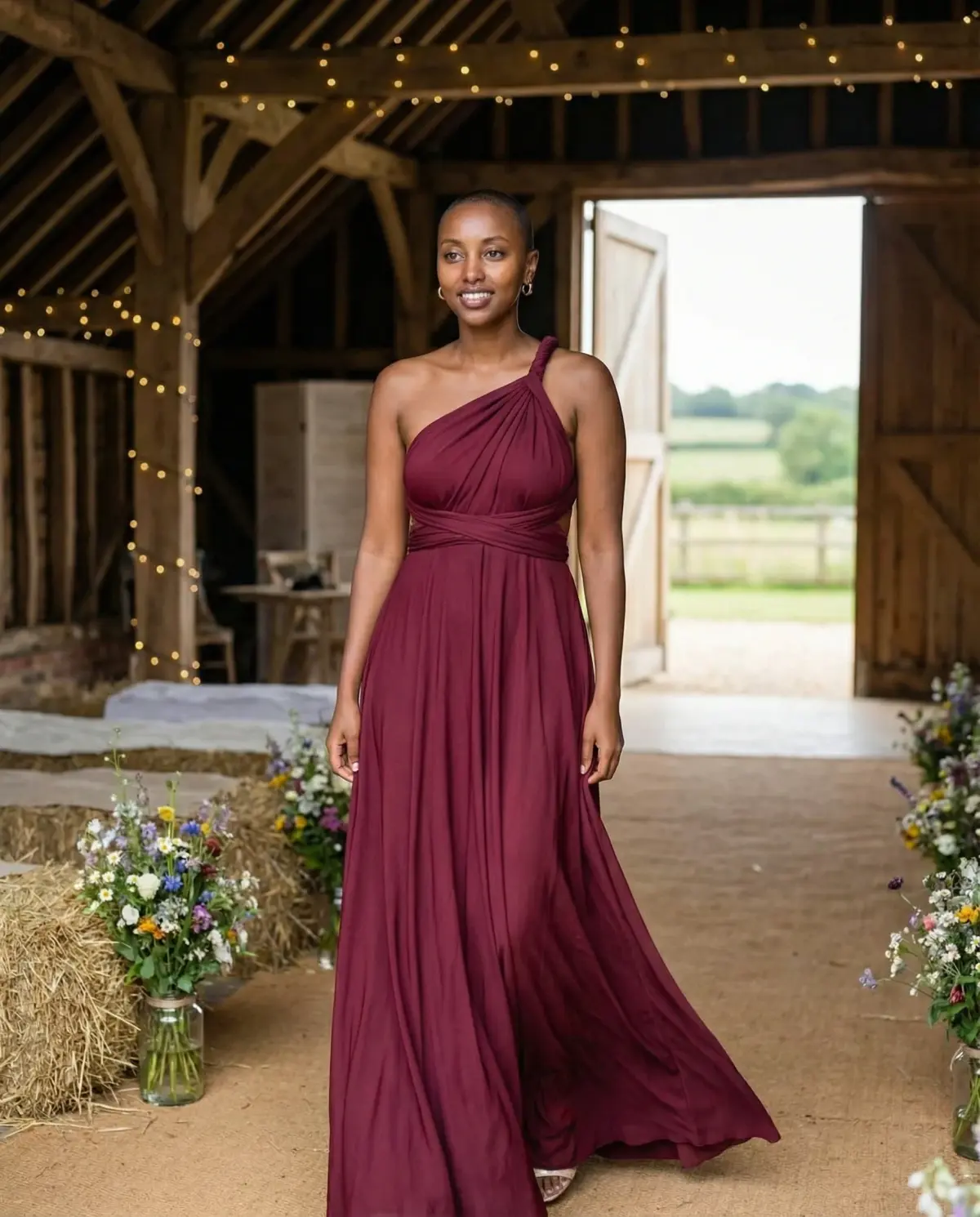
4. One-Shoulder
One panel is pulled up over a single shoulder and tied at the opposite hip; the other panel wraps the waist. The result is an asymmetric drape with a single bare shoulder.
Choose one-shoulder if: you want a modern, fashion-forward look that still feels bridal-party appropriate. It's especially flattering if you have one shoulder you prefer to show (some brides have tattoos or scars they'd rather cover or feature on a specific side).
5. Off-Shoulder / Bardot
Both panels are pulled wide and low across the upper arms, creating a horizontal neckline that sits just below the shoulders. The panels then tie at the back.
Choose off-shoulder if: you want romantic, slightly vintage styling — perfect for garden weddings, vineyard ceremonies, and venues with a soft, painterly aesthetic. Skip it if your venue is windy; the look only works when the panels stay perfectly placed.
6. Cross-Back
The front looks strapless or sweetheart, but the panels cross dramatically across the bare back in an X or a series of twists. All the visual interest is on the back.
Choose cross-back if: the wedding photographer is doing a lot of "walking down the aisle from behind" or "bridesmaids facing the altar" shots. It's also the best option for petite bridesmaids — the back detail draws the eye up and creates the illusion of height.
How to Wear a Convertible Maxi Bridesmaid Dress: Step-by-Step
This is the section every bridesmaid actually needs. The instructions below are for the most common wrap-front configuration on a standard maxi-length convertible (the cut Azazie, Birdy Grey Grace, and David's Bridal all sell). It's the most flattering, most secure, and most photographed of all the conversions — master it first.
You'll need: the dress, a full-length mirror, fashion tape (Hollywood Tape or equivalent), 2–3 small safety pins, and a partner if possible.
-
Step into the dress from the top. Most convertibles have no zipper — they're stretchy enough to step into. Pull it up to your waist first, then step the bodice on like a tube top. Don't pull from the panels; pull from the bodice itself.
-
Position the bodice band. The elastic or boned band at the top of the bodice should sit straight across your bust, just above the nipple line. Adjust until it's perfectly horizontal — a tilted band ruins every wrap style.
-
Pin the inner panel (optional but smart). Use one safety pin on the inside of the bodice center-front to anchor the bodice to your bra band. This single pin prevents the entire dress from sliding down during dancing.
-
Identify your two panels. They should be hanging down in front of you from the top corners of the bodice. Hold one in each hand and shake them out so they're untwisted.
-
Cross the panels at the chest. Bring the right panel across your body to your left side and the left panel across to your right side, forming an X over your bust. The X should sit roughly two inches below your collarbone for the most flattering V-neckline.
-
Bring each panel up over the opposite shoulder. The right panel (now on your left side) goes up and over your left shoulder. The left panel goes over your right shoulder. Don't twist them yet.
-
Cross the panels at your back. Have your partner bring both panels behind you and cross them in an X between your shoulder blades. If you're doing this solo, pull each panel behind you one at a time.
-
Wrap the panels around your waist. From the back X, bring each panel forward around your ribcage. They should sit at your natural waist (the smallest part), not your hips.
-
Tie a flat knot at the front or side. Cross the panels once, then again, into a flat square knot. Tuck the loose ends inside the wrap around your waist so they disappear. If you prefer the knot at the back, tie it there instead — both look polished.
-
Adjust the front V. Reach up and tug each panel near the bust to deepen or shallow the V to your taste. Wider apart = more cleavage; closer together = more conservative.
-
Apply fashion tape. Run two strips of fashion tape along the inside of each panel where it crosses the bust. This locks the V in place so it doesn't shift while you raise your arms for hugs and photos.
-
Do a dance test. Before you leave the room, raise your arms over your head, twist side to side, and pretend you're hugging someone. If anything slips or the V opens too wide, add another piece of tape or a second safety pin.
Tip from the bridesmaid trenches: practice the wrap three times on three separate days before the wedding. Muscle memory is the difference between "I look incredible" and "I'm hiding in the bathroom asking the photographer to help me re-tie."
For the halter version, replace steps 5–9 with: pull both panels straight up from the bust, cross once at the back of the neck, bring around the front, and tie behind the neck under your hair. For the one-shoulder, pull only one panel over one shoulder and tie the other panel around the waist alone. The base steps (1–4 and 10–12) stay identical.
Why Brides Choose Convertible Dresses for Their Party
The convertible category exploded around 2018 when the "mismatched bridesmaid" trend collided with the practical reality of dressing five women with five different bodies. Convertibles solve the problem in a way that no other category does:
- One color, one fabric, one SKU. Every dress photographs identically because they're literally the same dress. No "this dye lot looks slightly more peach in the sun" disasters.
- Different body types, different flattering cuts. Your fuller-busted bridesmaid wears the wrap front. Your athletic bridesmaid wears the halter. Your petite bridesmaid wears the cross-back. Everyone gets the cut that suits her.
- Heights become a non-issue. Maxi-length convertibles use a stretchy bodice that sits at the natural waist regardless of torso length. The skirt grazes the floor on tall bridesmaids and pools slightly on shorter ones — both look intentional.
- Post-wedding rewearability. A strapless maxi in dusty blue is a one-time dress. A convertible maxi in dusty blue is a halter cocktail dress for date night, a one-shoulder for a gala, and a wrap maxi for vacation. Bridesmaids actually keep these.
- Mismatched without the chaos. You get the "every bridesmaid looks unique" Pinterest aesthetic without sourcing six different silhouettes from six different brands.
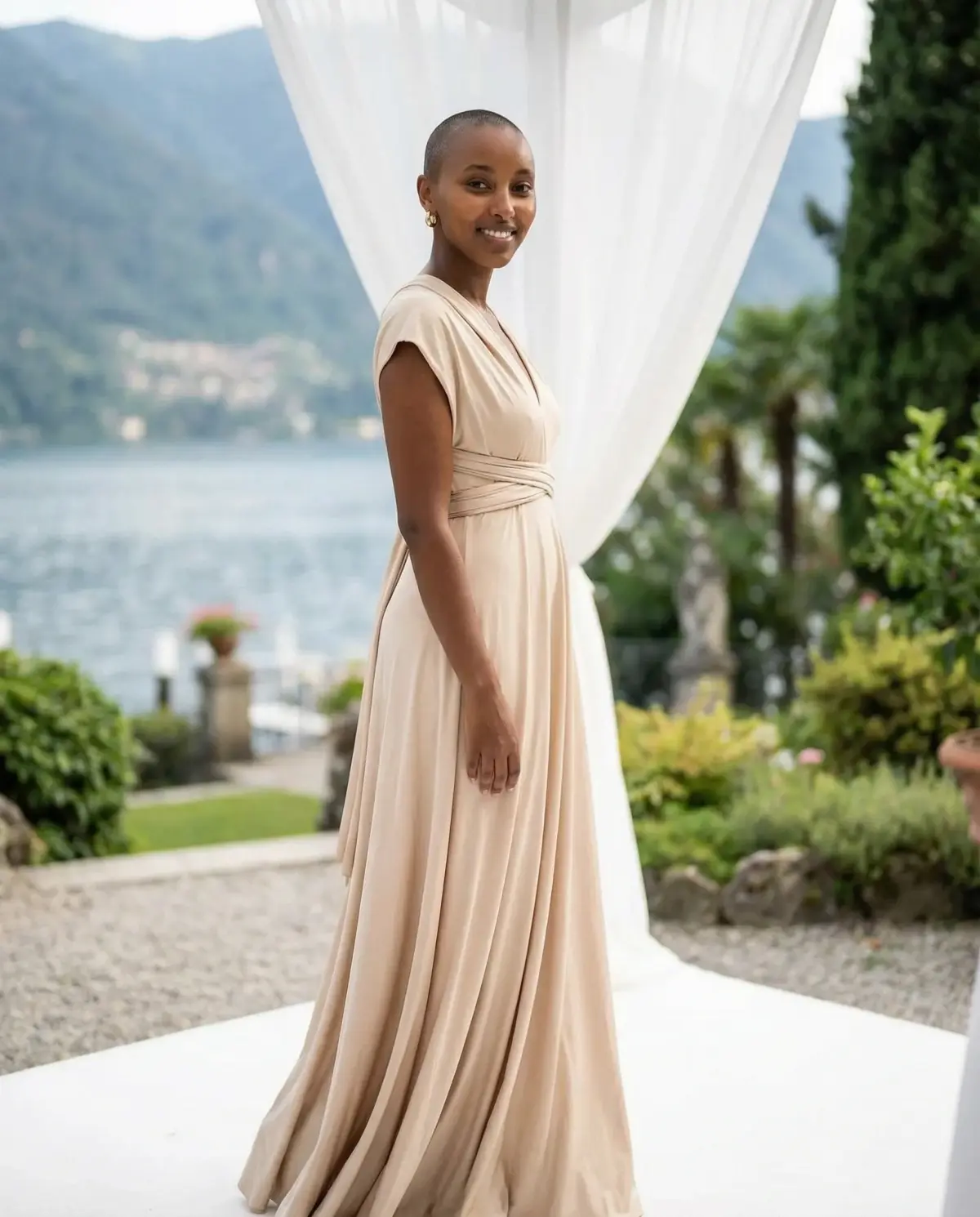
Convertible Bridesmaid Dress by Body Type
The whole point of convertibles is letting each body wear the most flattering version. Here's the cheat sheet your bridesmaids can screenshot.
| Body Type | Best Conversion | Why It Works |
|---|---|---|
| Pear (hips wider than shoulders) | A-line halter | Halter widens the visual line of the shoulders, balancing the hips. |
| Hourglass (balanced top and bottom) | Wrap front | Defines the natural waist and lets curves do the talking. |
| Apple (fuller midsection) | Empire halter | Gathers fabric just under the bust, skimming the midsection without clinging. |
| Petite (under 5'4") | Cross-back | Vertical interest at the back elongates the frame; halter or one-shoulder also lift the eye. |
| Tall (over 5'9") | Wrap front or off-shoulder | Both add horizontal interest at the bust to break up a long torso. |
| Plus-size | Wrap front with built-in support | The X across the bust provides structure; pair with a bodice that has internal boning. |
| Athletic (broad shoulders) | Strapless or sweetheart | Removes shoulder lines that emphasize broadness; lets the collarbone and decolletage shine. |
If you're still unsure which conversion suits each bridesmaid, that's exactly where AI try-on saves your group chat: try every configuration on with TryMyDress before anyone commits.
Best Colors & Fabrics for Convertible Dresses
Fabric choice matters more for convertibles than for fixed-cut dresses because the panels need enough body to hold a shape, but enough drape to fall prettily.
| Fabric | Pros | Cons | Best For |
|---|---|---|---|
| Jersey / matte stretch | Holds wrap shapes crisply; doesn't wrinkle in the car | Clings to every lump and bra line | Slim and athletic builds |
| Chiffon | Floats beautifully in photos; forgiving over the hips | Wrinkles instantly; needs steaming on-site | Most body types, garden weddings |
| Satin | Photographs richly; rich color depth | Shows every wrinkle; can look shiny under flash | Formal evening weddings |
| Crepe | Best balance of structure and drape; wrinkle-resistant | Slightly more expensive | High-end bridal parties |
| Tulle (skirt only) | Romantic, fairy-tale silhouette | Only works as the skirt; bodice still needs jersey | Spring and outdoor venues |
For colors, the most photogenic convertible shades in 2026 are sage green, dusty blue, terracotta, burgundy, champagne, and mauve. They all hold up across different lighting conditions (golden hour, harsh midday sun, candlelit reception) and they all look intentional next to a white wedding dress.
Avoid pure white (competes with the bride), neon brights (cameras hate them), and pale yellow (almost universally unflattering on photos with mixed skin tones).
Sizing & Ordering Tips
Convertible dresses are more forgiving than structured dresses, but they're not infinitely forgiving. Get sizing wrong and the wrap won't sit right — you'll either show too much skin or have panels that don't reach all the way around.
Order to your largest measurement. If your bust is a size 10 but your hips are a size 14, order the 14. Convertibles are stretchy enough up top to handle a slightly looser bust, but a too-tight skirt won't hide a thing.
Use custom sizing if available. Azazie offers free custom sizing on most convertibles — your bridesmaids submit bust, waist, hip, and height, and the dress is cut to those exact measurements. For groups with widely varying body types, this is worth the slightly longer lead time.
Order at least 12 weeks before the wedding. Standard sizes ship in 4–6 weeks; custom sizes can take 8–10. Add buffer for alterations (yes, even convertibles sometimes need hemming) and a backup-shipping window in case dye lots don't match between orders.
Order one extra dress. If your party is six bridesmaids, order seven dresses. The seventh is your insurance policy against tears, lipstick, and the bridesmaid who forgets her dress at home.
Don't size up "just to be safe." A too-large convertible wraps loosely and slides down your bust during dancing. True-to-measurement is always better than oversized.
Convertible Bridesmaid Dress FAQ
How do you tie a convertible bridesmaid dress?
Step into the dress, position the bodice band straight across your bust, then identify the two long fabric panels hanging from the top of the bodice. For the most popular wrap-front style, cross the panels at your chest in an X, bring each panel up over the opposite shoulder, cross them again at your back between the shoulder blades, wrap each panel forward around your waist, and tie a flat square knot at the front or side. Adjust the front V by tugging the panels nearer or farther apart, then secure the cross with fashion tape so it stays put. Most convertibles can also be tied as a halter (panels straight up and tied behind the neck), one-shoulder, off-shoulder, or strapless using the same starting position and a different routing of the panels.
Are convertible bridesmaid dresses worth it?
Yes, especially for parties of three or more bridesmaids with different body types, heights, or personal style preferences. You get one consistent color and fabric across the entire group (which photographs beautifully), but every bridesmaid can choose the conversion that flatters her most. Convertibles are also significantly more rewearable than traditional bridesmaid dresses — a dusty blue convertible maxi can be styled as a halter cocktail dress, a one-shoulder evening look, or a wrap maxi for vacations long after the wedding. The only times they aren't worth it: very small parties of one or two where coordinating fixed cuts is easy, or ultra-formal black-tie weddings where structured architectural gowns make more sense.
What size should I order for a convertible bridesmaid dress?
Order the size that matches your largest measurement — usually hips or bust. If you fall between sizes, size up rather than down; convertibles drape more naturally than they cling. Whenever possible, use the brand's custom sizing service (Azazie offers it free, BHLDN charges a small fee). Submit your bust, waist, hip, and height measurements taken with a soft measuring tape over your underwear. Avoid sizing up by more than one increment — a too-large convertible will slide down during dancing because there's no zipper or boning to hold it in place. If your group is mixed across the size range, custom is worth the extra two weeks of lead time.
Can you wash a convertible bridesmaid dress?
Most convertible bridesmaid dresses are dry-clean only because of the bodice boning, internal bra cups, or delicate satin and chiffon panels. Always check the care label before doing anything — some jersey and crepe versions can be hand-washed in cold water with a gentle detergent and laid flat to dry. Never machine-wash a convertible (the panels tangle into knots that can stretch the fabric permanently) and never tumble-dry one. After the wedding, take it to the dry cleaner within a week — sweat, makeup, and food stains set fast and become harder to remove the longer they sit.
Will a convertible dress stay up all night?
Yes, if you set it up right. The three things that keep a convertible secure through dancing are: (1) a safety pin connecting the inside center-front of the bodice to your bra band, (2) two strips of fashion tape running along the inside of each panel where they cross the bust, and (3) a tightly tied square knot at the back or front of the wrap. Strapless and off-shoulder configurations are the most prone to slipping; halter and wrap-front are the most secure because the weight is anchored at the neck or shoulders. If you're worried, do a "dance test" before the ceremony — raise your arms, twist side to side, and pretend to hug someone. Anything that slips during the test will slip ten times worse on the dance floor.
See Each Style on Yourself Before You Order
Reading about wrap configurations is one thing. Seeing the burgundy one-shoulder on your actual body — versus the sage cross-back, versus the dusty rose strapless — is the only way to know which conversion will photograph well at the wedding.
Upload a single photo to TryMyDress and you can preview every convertible style, color, and configuration in seconds. Halter on you, wrap on her, strapless on the maid of honor, all in the same dusty blue. No measuring tape, no dressing room, no "ship it back" anxiety.
Try on every convertible style for free →
Where to Shop
Once you know which styles look best on you, shop here:
- Birdy Grey – Convertible bridesmaid collection led by the Grace dress — 20+ styling options from halter to off-shoulder to wrap, $99. Genuinely transforms, not a faux-convertible strap shuffle. Shop Birdy Grey Convertible →
- Azazie – 500+ convertible bridesmaid silhouettes in chiffon, satin, and tulle. Free custom sizing means each bridesmaid can order her exact measurements — ideal when body types vary. Shop Azazie Convertible →
- Anthropologie (BHLDN) – Curated convertible and multi-way bridesmaid dresses in vintage-inspired fabrics. Good pick when you want convertible styling without the fast-fashion look. Shop Anthropologie →
- David's Bridal – Convertible bridesmaid styles with in-store fitting support across the US. Useful if some of your bridesmaids want to try configurations in person before the group orders online. Shop David's Bridal →
Explore These Styles
See AI-generated images for these dress silhouettes:
- Wrap & Asymmetric Dresses →Draped fabric with asymmetric hemlines or wrap details.
- Two Piece Dresses →Separate crop top and skirt for a modern, fashion-forward look.
- A-Line Dresses →Classic silhouette that flares gently from the waist, flattering on all body types.
- Sheath Dresses →Slim, form-fitting silhouette that skims the body.